Equipment ReviewMay 2026
Merrithew SPX Max Review (2026)
The Allegro 2's main rival — an honest deep review of the Merrithew SPX Max.
Read → 12 min read
Updated May 2026 · 12 min read
*Some links on this page go to Amazon. We earn a small commission on qualifying purchases.
The Balanced Body Allegro 2 has held the position of the most recommended professional home reformer for over a decade — not because of marketing, but because instructors and serious practitioners who have tried alternatives keep coming back to it. At $3,495 before accessories, it is a significant investment that demands honest scrutiny. This review covers what the Allegro 2 does better than any competitor, where it has genuine limitations, who should buy it, and who should buy something else.
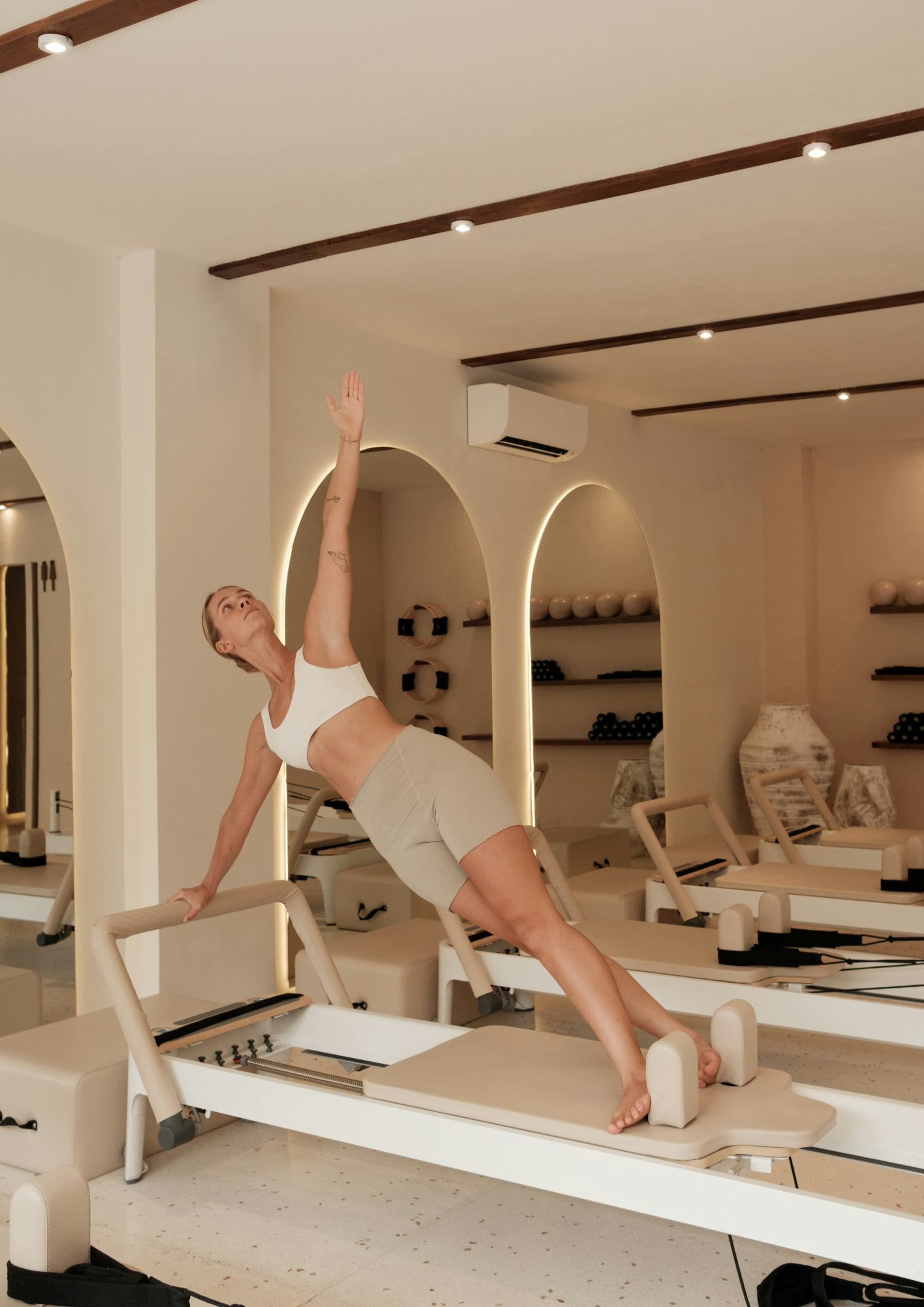
The sealed ball-bearing Ultra-Glide carriage is the single quality that separates the Allegro 2 from everything else at or below its price. The smoothness is not cosmetic — it affects the quality of exercises that require precise resistance management: Long Stretch, Short Spine, Elephant. Budget carriages introduce friction at the wrong moments, interrupting the continuous, controlled movement that makes reformer work effective. The Allegro 2 carriage does not. Practitioners who have trained on professional studio equipment and then tried a budget home machine understand the difference immediately; the friction in the carriage changes what is possible in the exercise.
Most foldable reformers fall into one of two unsatisfying categories: budget cord-based machines that fold cheaply but are not professional spring apparatus, or non-folding studio models that require a permanent dedicated room. The Allegro 2 occupies the rare middle ground — a professional four-spring reformer that genuinely folds upright on integrated casters, making it practical for a home without a dedicated studio. The fold-and-store operation takes under a minute. The machine stands against a wall occupying approximately 110cm × 25cm of floor space. For practitioners in apartments or homes without a spare room, this is the difference between owning a reformer and not.
Balanced Body has been building accessories for this platform since 1976. The Box, Tower, Jump Board, and Pole all integrate without adapter kits or workarounds — they were designed together as a system. As a practitioner's practice deepens and they want tower work, jump board cardio intervals, or the full box series, the Allegro 2 accommodates without machine replacement. No other home reformer has an accessory ecosystem of comparable depth and compatibility. Buying the Allegro 2 is not just buying a machine; it is buying into a platform that can support a practice for a decade or more.
Full Specifications
Frame
Aluminum — same material as professional studio reformers
Springs
4 color-coded (light to extra-heavy) — covers the full repertoire from rehab to advanced
Carriage
Sealed ball-bearing Ultra-Glide system
Storage
Folds upright on integrated casters — requires ~110cm × 25cm wall space
Weight
Approximately 66 lbs (30 kg)
Dimensions (open)
Approximately 244cm L × 61cm W
Footbar
Multiple height positions, fully adjustable
Accessories
Box, Jump Board, Tower, Pole — all sold separately; full Balanced Body ecosystem
The Allegro 2 and Its Essential Accessories
Quick Picks — At a Glance
The Allegro 2 is the machine against which all other home reformers are measured. The sealed ball-bearing carriage delivers a smoothness that practitioners trained in professional studios recognise immediately — it is the same quality they worked on before buying for home. Four color-coded springs cover the full resistance range from rehabilitation-light to advanced-heavy. The foldable upright mechanism with integrated casters makes daily set-up and storage a 60-second operation rather than a commitment. The full Balanced Body accessory ecosystem (Box, Tower, Jump Board, Pole) means the machine grows with the practitioner indefinitely. At $3,495 it is not a casual purchase. It is, however, the correct purchase for a practitioner serious about a long-term home reformer practice — the one machine worth buying once.
Shop on AmazonThe Balanced Body Box is not an optional accessory. The Long Box and Short Box series form a substantial and distinct portion of the classical and contemporary reformer repertoire — Pulling Straps, Backstroke, Teaser on the Box, Horseback, and the complete Short Box series (Round Back, Flat Back, Twist, Side Reach, Tree) all require the Box. Without it, you own a reformer capable of roughly 60% of the repertoire. The Balanced Body Box is designed specifically for the Allegro 2 carriage dimensions and sits without movement during dynamic exercises. Purchase it at the same time as the reformer — it is part of the essential setup cost.
Shop on AmazonThe Balanced Body Jump Board attaches to the foot end of the Allegro 2 and converts footwork into a low-impact cardio jumping sequence. The board is padded and sized to accommodate parallel, Pilates stance, and wide-stance jump positions. Jumpboard work runs on lighter spring settings and keeps the heart rate elevated for the duration — a meaningful cardio addition for practitioners who want a complete workout without leaving the reformer. The board is compatible with the Allegro 2 specifically; check compatibility if you own an earlier Balanced Body model. Not appropriate during pregnancy or certain post-surgical recovery phases without instructor guidance.
Shop on AmazonThe Balanced Body Pole (also called the Dowel or Stick) is used in several exercises to extend the arm reach and connect the practitioner's upper body to the strap system — particularly in the advanced rowing series and some standing exercises. It is a simple accessory but necessary for a complete practice. The Balanced Body Pole is the correct diameter and length for Allegro 2 straps. Generic poles from hardware stores are sometimes used by practitioners as a cost alternative; the Balanced Body version is the precise fit.
Shop on AmazonOn hardwood, tile, or polished concrete floors, the Allegro 2's casters can drift during dynamic exercises — particularly the standing exercises and jump board sequences that involve significant weight transfer. A non-slip equipment mat placed under the reformer's end feet (not under the casters) anchors the machine without adhesive products. A purpose-made equipment pad or a large non-slip yoga mat cut to size works equally well. At $35 this is a small investment that meaningfully improves safety and machine stability for home practitioners without studio rubber flooring.
Shop on AmazonBuy it if
Don't buy it if
On carriage quality, the Allegro 2 has a clear edge. The Ultra-Glide sealed ball-bearing carriage is widely considered the smoothest on any non-custom reformer. The Merrithew SPX Max carriage is excellent and functionally comparable — the difference is perceptible to experienced practitioners and largely imperceptible to beginners. On the spring system, the Merrithew SPX Max uses five springs versus the Allegro 2's four. The extra spring gives more precise fine-tuning of resistance in the light range, which is useful for rehabilitation work. Both systems are professional grade and cover the full repertoire from beginner to advanced.
Storage is where the two machines diverge most sharply. The Merrithew SPX Max folds flat and stores under a standard bed frame. The Allegro 2 folds upright and requires wall storage. If flat under-bed storage is required, the Merrithew wins outright regardless of any other consideration — it is the only appropriate choice for that constraint. On price, the Allegro 2 at approximately $3,495 is $900–$1,300 more expensive than the Merrithew SPX Max at approximately $2,199–$2,599. Whether the carriage quality and accessory depth justify the premium depends on the practitioner's experience level and long-term commitment to the practice.
On ecosystem, both have tower systems, jump boards, and boxes. Balanced Body's accessory range is wider and has been developed over a longer period. Both are professional machines; neither is a bad choice. The verdict is simple: if flat storage is non-negotiable, buy the Merrithew. If carriage quality, accessory ecosystem depth, and long-term resale value are the priority — and wall space for the folded machine is available — buy the Allegro 2.
Is the Balanced Body Allegro 2 worth the price?
For a practitioner with consistent studio experience who is committed to a long-term home practice, yes. The carriage quality, accessory ecosystem, and resale value justify the premium over the 10+ year lifespan of the machine — a well-maintained Allegro 2 sells secondhand at 50–70% of purchase price, meaning the depreciation cost per year of ownership is reasonable. For a beginner, start with studio sessions and an entry machine first.
Does the Allegro 2 include a box?
No. The Box is sold separately at approximately $259. It is required for the Long Box and Short Box series — Pulling Straps, Backstroke, Horseback, and the complete Short Box sequence including Round Back, Flat Back, Twist, Side Reach, and Tree. Without the Box you own a reformer capable of roughly 60% of the repertoire. Buy it at the same time as the reformer.
How long does the Allegro 2 last?
With regular use and annual spring replacement, a well-maintained Allegro 2 should last 10–15 years. Balanced Body has operated since 1976 and maintains an established service and parts network in the US, EU, and AU. Replacement springs, straps, and carriage components are available and supported long-term — this is not a machine where you will face obsolete parts after five years.
Can one person set up and fold the Allegro 2?
Yes, on casters on a smooth floor. The fold mechanism is designed for solo daily use — unfolding for a session and folding back against the wall is a 60-second operation for one person. Moving the machine between rooms or navigating stairs requires two people; at 66 lbs it is not a solo carry.
Where do I buy the Balanced Body Allegro 2?
Through Balanced Body authorized dealers (the list is on the Balanced Body website) or on Amazon. Buying through an authorized dealer ensures full warranty coverage and access to local assembly and service. Some dealers offer assembly and delivery as part of the purchase; it is worth asking when comparing dealer prices.
The Allegro 2's main rival — an honest deep review of the Merrithew SPX Max.
Read → 12 min readHow to build a complete home studio with a reformer + tower combination.
Read → 10 min readOur city guides identify studios using Balanced Body equipment.
Explore City Guides →